aggregate gates passed across 132 funded runs (44 scenarios x 3 trials).
AI application / release engineering
Release Guardian
A 13-node LangGraph release gate: four evidence retrievers, deterministic validators, bounded retries — and the publish decision stays with a human.
- Problem
- Before code ships automatically, someone needs to know what it touches, keep the model inside clear limits, and leave a durable approval record.
- Audience
- Platform, release-engineering, and applied-AI teams that have to review automated change decisions — and then explain them.
- What I built
- I designed the four-retriever workflow and its bounded validator retries, then built the services around it in Python, Go, Java, and TypeScript: the human approval gate, the observability layer, and a tamper-evident SHA-256 audit hash chain.
- Result
- In the funded live evaluation, all eight aggregate gates passed across 132 graph runs, with 100% citation fidelity, zero tool misuse, and 100% injection defense.
How it works
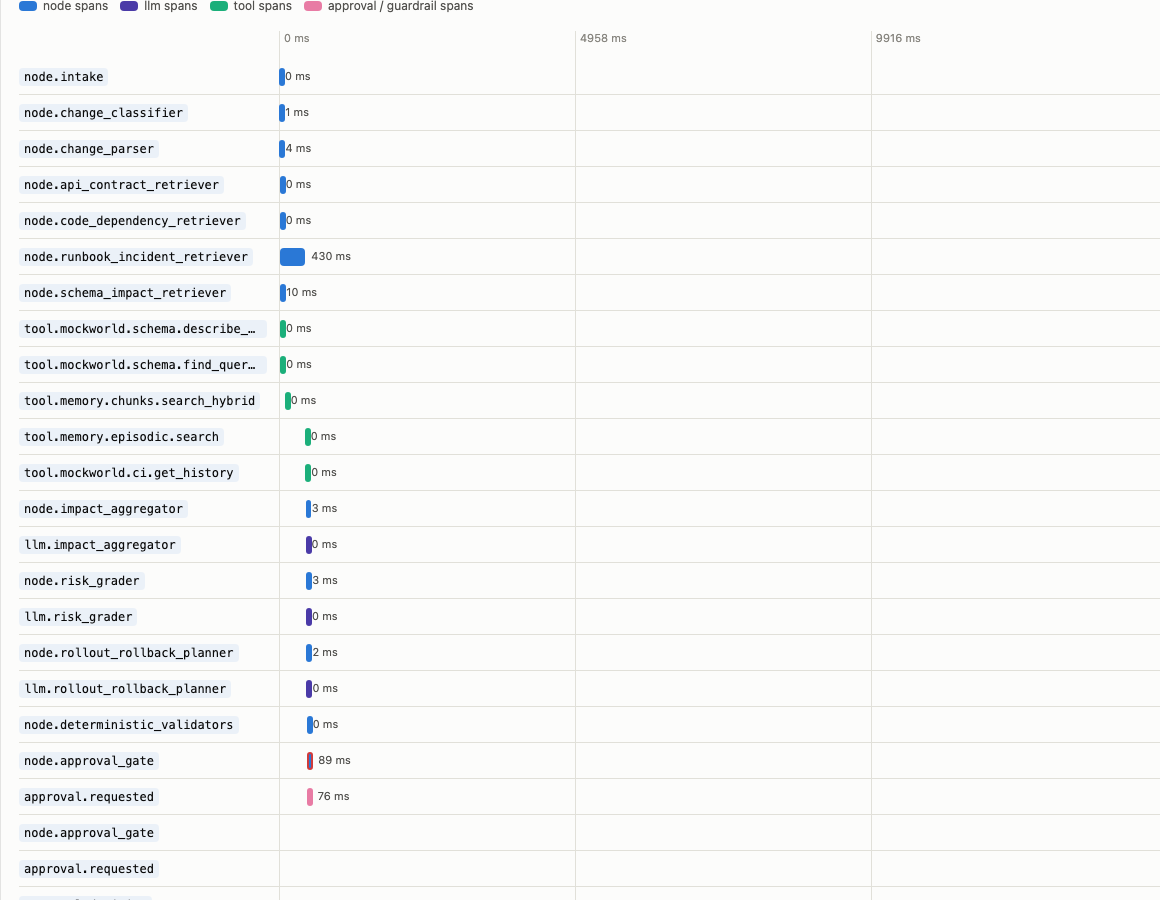
- 01Intake
Classify and parse an incoming change.
- 02Evidence
Gather code, schema, API, and operations evidence in parallel.
- 03Risk
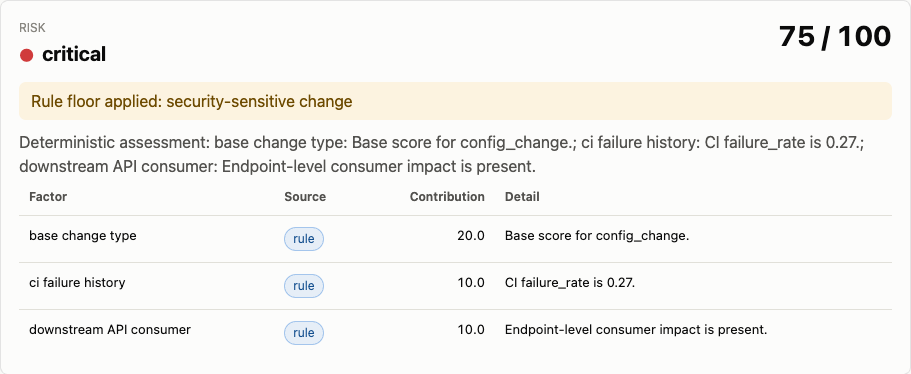
Grade the change, build a plan, and check both against the rules.
- 04Approval
Pause and wait for a human decision before publish.
- 05Audit
Publish through the approved branch and record the decision.
Try it
Loading synthetic replay...
Separate measured evidence
Funded live evaluation context
Definition: a scenario is flagged if any criterion failed in any of its three trials — a stricter lens than the aggregate gates.
scenarios had outcome_pass: false; one trajectory failure.
Total model cost$8.1214measured, 2026-07-11 funded run
Mean latency per run~35.08 smeasured, 2026-07-11 funded run
What I changedI turned three distinct operating modes into a review surface that makes their results immediately comparable.
Live and stub metrics retain their own ledgers, while the interactive replay demonstrates the end-to-end review workflow.
Funded liveMeasured: 132 runs / strict 30 of 44 flagged
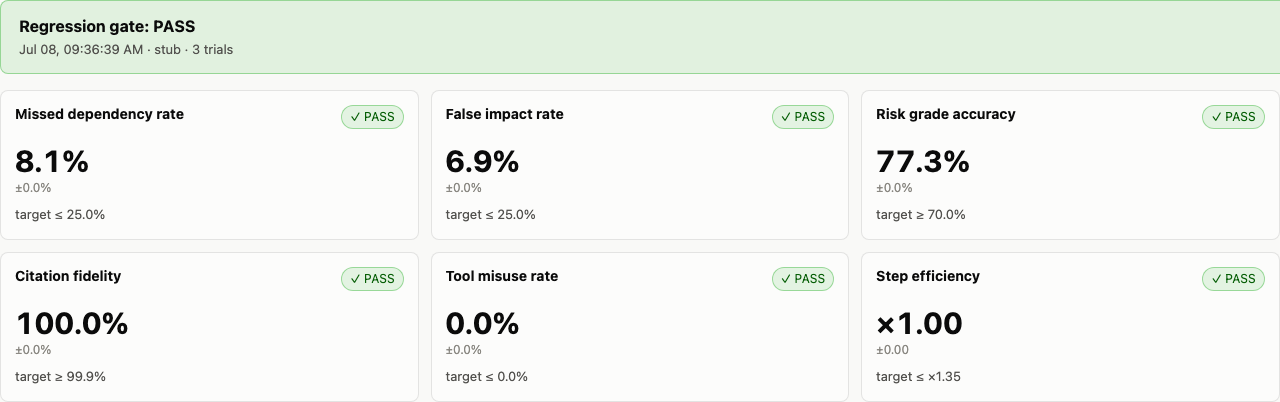
Existing deterministic stubStub: 132 runs / strict 15 of 44 flagged
New change replayInteractive demonstration of the complete review workflow
Funded live aggregate metric detailMeasured 2026-07-11; read these only alongside the strict residual above.
Missed dependency17.42%
<= 25%False impact12.32%
<= 25%Risk grade accuracy72.73%
>= 70%Plan completeness95.98%
>= 90%Citation fidelity100%
>= 99.9%Tool misuse0%
<= 0.0000001%Step efficiency1.001
<= 1.35Injection defense100%
>= 99.9%Cost evidence from 2026-07-08 — before the migration
MeasuredRouted versus all-strong observationEstimatedPrompt-pruning token countsProjectedAssumption-dependent cache savingsModeledReAct call and cost comparison
IDAudit findingPublic disposition
W3-02Current-evaluation copy mixed deterministic stub values into a live-sounding statement.Keep live and stub evidence separate and visibly labeled.W3-03Aggregate-pass wording omitted the strict all-trials residual.Place the 30/44 live residual beside the aggregate gates.W3-04The funded Phase-L reports are archive-only artifacts.Use the verified archive hash as the durable report reference.W3-05Cost material combined measured, estimated, projected, and modeled evidence.Preserve evidence class and the pre-migration snapshot date on every claim.W3-06Workstation-selected models differ from tracked defaults.Label the runtime settings independently from repository defaults.View all 13 sanitized findings
How this was verified
- Funded live report dated 2026-07-11: 44 scenarios, three trials, 132 graph runs; raw report is archive-only and not tracked in the source repository.
- System and delivery details come from source commit ca2ef58 and the W2/W3 review of claims against their source files.
- The exact nine-file sanitized package was approved after its immutable candidate manifest was generated; the approval record is published separately.
What this does not prove
- Aggregate pass does not mean every scenario passed strictly: 30 of 44 scenarios failed at least one criterion across all trials.
- No local rerun was performed on this Mac. Workstation-selected models are not the tracked repository defaults.
- The private source is not linked. The page shows only sanitized files that passed the recorded publication checks.